Battery ownership guide
EV Battery Health, Degradation, and Warranty: What Owners Can Check
Understand capacity change, charging habits, battery reports, warranty documents, and sensible checks when buying or maintaining an EV.
Understand capacity and range
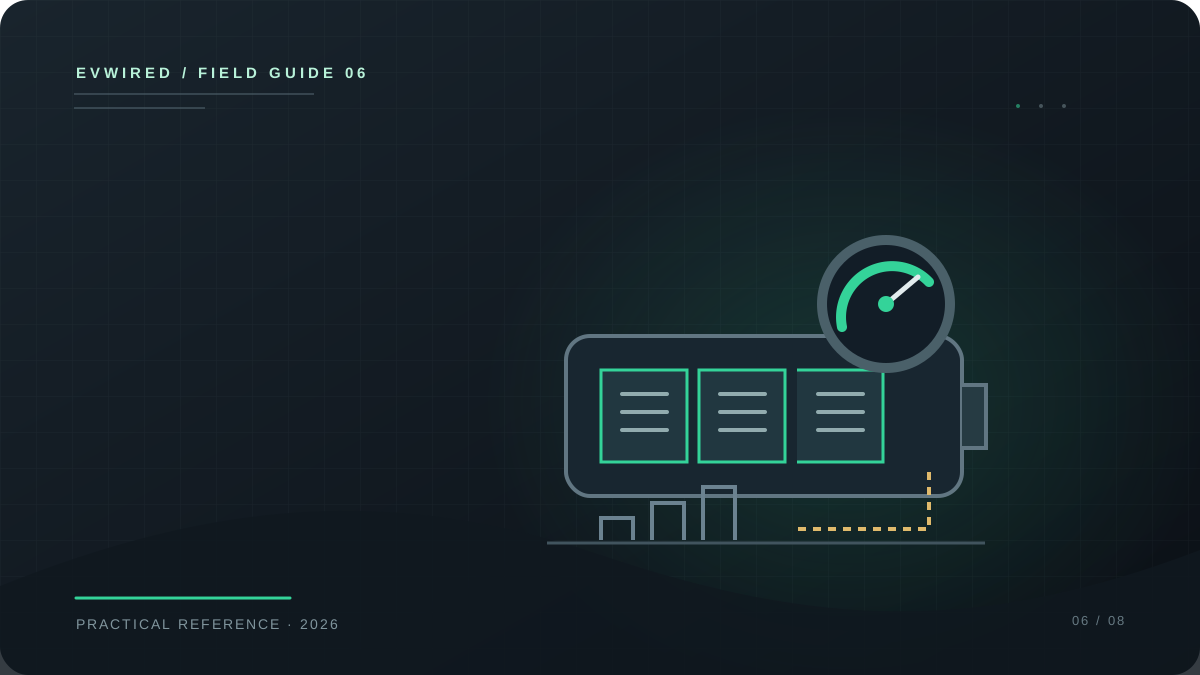
A traction battery stores energy for the vehicle's motor and systems. Over time, usable capacity can change, but the size and pace of change vary with battery design, chemistry, temperature, charging, age, and use. A dashboard range number is not a direct laboratory measurement of battery health: it also responds to recent consumption, conditions, software assumptions, and the charge level. A lower range estimate after a cold week does not by itself prove permanent capacity loss.
Distinguish energy capacity from power capability. A vehicle may have enough stored energy for a normal trip but charge more slowly under cold or high state-of-charge conditions. Battery management systems monitor pack operation and can limit power to protect components. Read the maker's descriptions for warnings and service messages. If the car reports a battery fault, overheating, isolation warning, or sudden unusual behavior, follow its instructions and contact qualified service. Avoid opening a high-voltage pack or attempting a repair without proper training and equipment.
What affects a battery over time
Battery aging is influenced by calendar time and operating cycles. High temperatures, long periods at a high or very low state of charge, and repeated high-power charging may affect some chemistries differently. Thermal management and battery software also matter, so a general rule from one vehicle cannot be applied to all models. The U.S. Department of Energy's discussion of battery life and replacement data is useful context, but it does not replace the manufacturer's specification for an individual vehicle.
Driving and charging conditions vary widely. A car in a hot climate may face different thermal demands from a vehicle in a temperate region; an owner with daily fast-charging needs differs from someone who charges slowly at home. The vehicle may manage temperature automatically, sometimes using energy while parked or connected. Follow the owner's manual for storage and charging limits, and avoid leaving a vehicle unused for long periods at an extreme charge level unless the maker's guidance specifically calls for it. Record unusual warnings, not every ordinary fluctuation in estimated range.
Follow model-specific charging advice
Many vehicles let owners set a daily charge target and a separate long-trip target. Use those settings as the manufacturer recommends for the exact battery and model year. Some vehicles advise routine limits below full charge, while others describe different chemistry-specific practices. A universal “always charge to this percentage” rule may conflict with the manual. The best routine balances battery guidance, departure needs, and reliable charging access. If the vehicle offers scheduled charging or preconditioning, learn how it operates and whether it requires the car to remain plugged in.
DC fast charging is convenient for travel, but the speed and thermal conditions matter more than the simple label “fast.” The vehicle can reduce power as the pack warms or fills, and station output is shared or limited by site conditions. When a road trip requires rapid charging, use the route planner and vehicle instructions. At home, use certified equipment installed for the property's electrical system. Avoid damaged cables, improvised adapters, or repeated charging faults. If charging is consistently much slower than the manual predicts under suitable conditions, ask an authorized technician to diagnose it.
Read the warranty itself
Battery warranty terms vary by manufacturer, country, model year, and vehicle category. Find the written warranty booklet for the exact VIN and market. Check duration, distance limit, capacity threshold if any, exclusions, required maintenance, and what counts as a covered defect. Some warranties cover battery failure and a defined level of capacity loss under stated conditions; others use different language. Do not assume a familiar term such as “eight years” means the same coverage for every battery, jurisdiction, or used-car owner.
Confirm whether coverage transfers to a subsequent owner and how a claim is evaluated. Ask the manufacturer or authorized service center to explain the process in writing. Separate the battery warranty from the general vehicle warranty, corrosion coverage, emissions coverage, and any extended service contract. A warranty may require repairs through an authorized channel or exclude damage from misuse, accident, or unauthorized alteration. Save the booklet, service invoices, software campaign records, and written responses. A verbal sales summary should not override the documents that control the claim.
Ask for a meaningful assessment
If you need a battery condition check, ask what the test measures and how it reports uncertainty. A diagnostic may show a state-of-health estimate, cell balance, fault codes, capacity test result, or simply that the system has no active warning. Those are not interchangeable outcomes. Request a dated written report from the manufacturer or a qualified independent specialist familiar with the specific model. Confirm whether the test needs a particular charge level, temperature, or appointment length, and whether the result affects the warranty.
Interpret an assessment with the car's age, mileage, history, and intended use. A single percentage without method or reference may create false confidence. Compare it with manufacturer service information and, where available, the warranty threshold. Watch for physical damage, underbody impact, water intrusion, repeated isolation warnings, or a history of battery replacement; have these assessed by professionals. Do not infer pack condition from one trip's consumption. If a seller refuses reasonable documentation for a high-value used car, treat that as a reason to seek another inspection or reconsider the transaction.
Use the information when buying used
Request the VIN, original warranty booklet, maintenance and repair records, charging history where available, and documentation for battery or software work. Check open recalls in the relevant national safety database and ask a dealer to confirm completion. A battery inspection should be independent of the seller's verbal assurances when possible. Compare the displayed range after a normal drive, but do not treat it as a health certificate. Test AC and DC charging if practical, inspect the charge port, and verify that every included cable and adapter matches the vehicle and your home setup.
Ask whether the vehicle spent long periods out of service, was used commercially, sustained an underbody collision, or experienced flood or fire exposure. Verify title status and local inspection requirements. A normal battery can still be paired with a car that has expensive issues elsewhere, such as suspension wear, tires, electronics, or outdated charging compatibility. Use a mechanic familiar with EV high-voltage safety, and never ask an unqualified inspector to open the pack. The most useful purchase decision combines a test drive, vehicle history, written warranty terms, independent diagnostics, and the total cost of any needed repairs.
Sources and further reading
These primary sources support the technical and consumer information in this guide. Local requirements and model-specific details can differ.
-
Electric Vehicle Maintenance and Safety
U.S. Department of Energy, Alternative Fuels Data Center
Maintenance and safety context for electric vehicles.
-
Plug-in Vehicle Battery Replacements Due to Failure
U.S. Department of Energy
U.S. Department of Energy summary of reported replacement data and its limits.
-
Recalls
National Highway Traffic Safety Administration
VIN-based recall lookup for vehicles in the United States.
-
Electric Vehicle Benefits and Considerations
U.S. Department of Energy, Alternative Fuels Data Center
General EV ownership, maintenance, and vehicle considerations.