Seasonal driving guide
Winter Driving in an EV: Range, Charging, and Preparation
Prepare for cold-weather EV driving with realistic range expectations, preconditioning, route planning, and everyday winter safety.
Why cold weather changes energy use
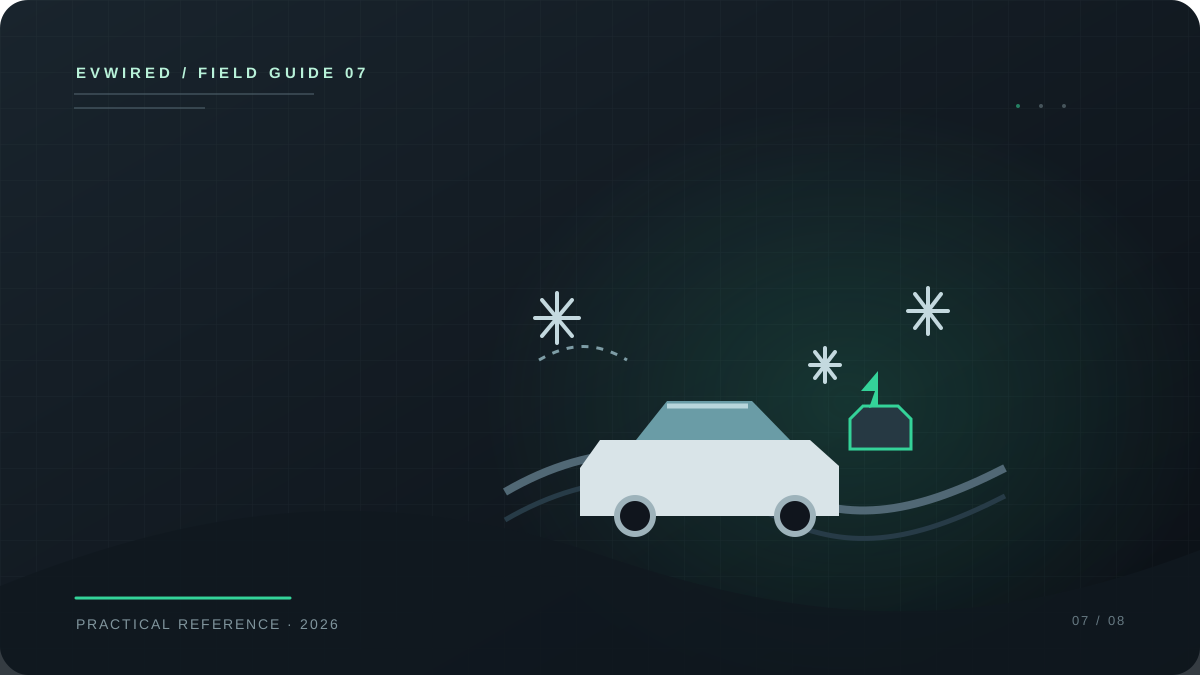
Cold weather can reduce the energy available from a battery in the moment and add energy demand for cabin heat, windows, and battery temperature management. The actual effect depends on vehicle design, trip length, temperature, wind, road surface, speed, and how the vehicle is parked. The U.S. Department of Energy describes laboratory findings in its cold-weather fact sheet; those controlled results are helpful context, not a prediction for every car or driver. A short cold trip may behave differently from a long drive after the car has warmed.
Heat pumps, resistive heaters, battery insulation, and thermal controls differ across models and trims. Winter tires can improve traction but may change efficiency. Snow, slush, headwinds, roof boxes, and high motorway speeds also affect energy use. A dashboard range estimate that drops after a cold start may be responding to expected heating and battery conditions rather than signaling a permanent fault. Learn the maker's cold-weather guidance and compare several trips under similar conditions before deciding whether a change is unusual.
Precondition while connected
Many EVs can warm or cool the cabin before departure, and some can prepare the battery for rapid charging. The exact controls and benefits vary by model. If the car is plugged in, scheduled preconditioning may draw some energy from the electrical supply rather than the traction battery, leaving more stored energy for the journey. Check whether your vehicle needs a departure timer, a navigation destination, or a manual command. Follow the instructions for using the feature safely, including whether it works while the vehicle is locked or unattended.
Preconditioning is not a reason to leave a vehicle in an unsafe location or run an unfamiliar feature without reading its manual. Confirm the cable and charger are in good condition, and ensure the charging schedule allows the car to reach its departure target. If the car has a battery heating function for DC charging, navigation may activate it only when a compatible fast charger is selected. A remote command may fail when mobile coverage is poor. Check the car in person before a critical trip instead of assuming an app command succeeded.
Plan a winter trip conservatively
Before a longer drive, use a route estimate that accounts for temperature and speed when available. Check weather warnings, road closures, wind, elevation, and charger operating status. Increase the planned energy margin if the route is unfamiliar, chargers are far apart, the car is heavily loaded, or conditions can deteriorate. It may be sensible to begin with a higher state of charge or stop earlier than in summer. Choose charging stops with multiple compatible stalls and identify an alternative within the energy available at that point.
Expect a longer stop if the battery is cold or the charger is busy. If your car supports battery preconditioning, set the fast charger as a navigation destination according to the maker's directions. Keep the next leg short enough that a delay or detour does not consume the full reserve. The AFDC public charging guide explains common station types in the U.S.; use current local maps for live availability. Carry winter emergency items appropriate for your region and make sure occupants can stay warm if a route is delayed.
Expect charging behavior to change
A cold battery can accept energy more slowly until it warms, so the power displayed at a DC charger may begin below the vehicle's peak rating. Charging speed also changes with the state of charge, station output, temperature, and how power is shared at the site. A charger advertising a high kilowatt figure does not guarantee the same rate for every vehicle. If charging appears unusually slow, check the vehicle's battery temperature guidance, station status, connector fit, and any active battery conditioning before concluding that the pack has a fault.
Follow the car's manual on charging in extreme cold and on parking when the battery is low. If the vehicle displays a warning or restricts operation, obey the message and contact service as directed. Do not use an open flame, unapproved heater, or improvised cable to warm a pack. At home, a regular plug-in schedule can help keep the car ready, but equipment must be appropriate for the electrical installation and local conditions. If a charger or connector is iced, damaged, or unsafe to handle, use another station and report the issue to the operator.
Balance comfort and road safety
Cabin heating is part of safe driving, especially when visibility or alertness depends on a clear, comfortable interior. Avoid turning off essential defrosting or heat simply to preserve a range estimate. Heated seats and steering wheels may use less energy than heating the entire cabin in some vehicles, but equipment differs; choose settings that maintain comfort and clear glass. Remove snow from windows, lights, mirrors, roof, and sensors before driving, as required by local law. Keep the windshield and cameras clear and check how snow may collect around driver-assistance sensors.
Use tires designed for expected conditions and maintain the pressure recommended by the vehicle maker, allowing for temperature-related pressure changes. Carry approved chains or traction devices when required, and know whether they fit the vehicle's wheels. Smooth acceleration and lower highway speed can reduce energy demand, but should never compromise safe traffic flow. Regenerative braking may behave differently on a cold or slippery surface; follow the manual and leave more stopping distance. Range planning cannot compensate for worn tires, poor visibility, or unsafe road conditions.
Use a repeatable winter routine
Track a few ordinary winter drives: temperature, speed, route, cabin settings, starting charge, and energy use. Compare like with like, and do not draw a battery-health conclusion from one very cold day. If the range difference remains large after conditions improve, or a warning appears, ask a qualified service center to inspect the vehicle. For a used EV, check whether the battery heater, heat pump, charging port, and thermal system were included on that trim and whether any relevant recalls are open.
A simple routine works well: check forecast and station status; plug in when the car is parked if convenient; precondition before departure; use the route planner; keep a safe reserve; and reassess when weather or traffic changes. The Department of Energy's winter EV tips and its cold-temperature explanation offer general U.S. context. Regional driving rules and emergency guidance should come from local authorities. Good winter EV use is not about chasing the warm-weather range figure; it is about matching the plan to the actual conditions and protecting people on the road.
Sources and further reading
These primary sources support the technical and consumer information in this guide. Local requirements and model-specific details can differ.
-
Winterizing Your Electric Vehicle
U.S. Department of Energy
Practical preparation advice for U.S. EV drivers in winter.
-
Effect of Cold Temperatures on Fuel Economy
U.S. Department of Energy
Controlled test context on cold-weather energy use; not a prediction for every vehicle.
-
Charging Electric Vehicles in Public
U.S. Department of Energy, Alternative Fuels Data Center
Public charging overview and charging behavior context.
-
Fuel Economy and EV Range Testing
U.S. Environmental Protection Agency
Official range test context for U.S. EVs.