Range guide
EV Range and Efficiency: How to Read the Numbers
Learn what official range ratings measure, why real trips differ, and how to compare EV energy use without relying on one dashboard estimate.
What a rated range tells you
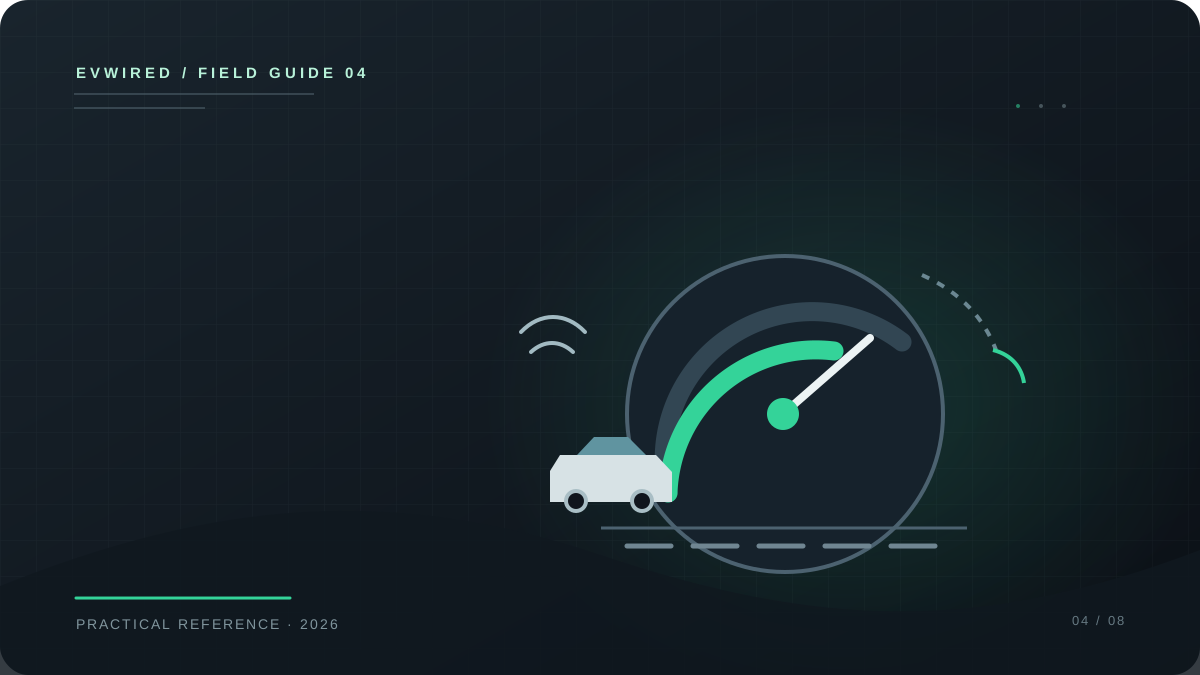
An official range figure is the result of a defined test procedure. It helps buyers compare vehicles tested under the same rules, but does not predict the exact distance every owner will travel. In the United States, the EPA explains laboratory cycles, adjustment factors, and the label in its EV range testing overview and label guide. Other markets use other procedures. When comparing two ratings, first check that they come from the same regulator and model configuration.
Read the figure together with test-cycle notes, wheel and tire options, drivetrain, and battery size. A vehicle sold with larger wheels or a different motor can carry a different official estimate from a nearby trim. Model-year changes can also affect the rating. Manufacturers may advertise an estimate that is not the official local test value, so look for the regulator's label or database when precision matters. A rating is useful context, not a guarantee, and a single headline number hides how a vehicle behaves on different roads.
Separate range from efficiency
Range describes how far a vehicle can travel under a specified test or set of conditions. Efficiency describes how much energy it uses to travel a distance. Units vary by market: kilowatt-hours per 100 kilometers, miles per kilowatt-hour, or another standardized measure. Check whether a number reflects energy from the wall or energy delivered to the battery; charging losses can make those values differ. A more efficient vehicle may travel farther with a similar usable battery, but capacity, vehicle shape, weight, tires, and software also contribute.
For ownership, energy per distance is often more informative than range alone. It helps estimate charging needs and cost, and it lets you compare two vehicles on a route you actually drive. Make sure units match before calculating. Convert carefully if one source reports mi/kWh and another kWh/100 km. On-board displays may reset over a short trip and vary with recent driving. EPA's consumption estimate provides a standardized comparison for U.S.-market cars, while a recent utility bill and observed travel can refine the operating-cost picture.
Conditions that change consumption
Speed and aerodynamics matter because pushing air aside takes more energy as speed rises. Headwinds and roof cargo can have a similar effect, while hills add energy use on the climb even if some energy returns on descent. Cold weather can affect battery performance and increase cabin heating demand; hot conditions can require cooling. Repeated short trips may spend a larger share of energy warming or cooling the cabin than one long drive. The effect differs by vehicle, route, weather, and driver, so avoid applying a single percentage to every EV.
Tire pressure, tire type, alignment, road surface, rain, snow, passengers, luggage, and towing can also change energy use. Some vehicles recover part of the energy during deceleration, but regenerative braking does not make stop-and-go driving automatically more efficient than every steady-speed trip. Climate control, heated seats, and preconditioning may alter consumption in ways the display does not explain at a glance. The practical question is whether your own common conditions remain within the car's useful operating window, not whether a vehicle can reproduce its official result on every commute.
Read the dashboard with context
A displayed remaining-range estimate usually combines usable battery energy with recent or predicted consumption. If you change from slow local roads to a fast motorway, the estimate may fall before the battery changes much. After slowing down or preconditioning, it may recover. That movement reflects a model recalculating from new conditions; it does not necessarily mean the battery has suddenly lost or gained capacity. Learn whether your car's estimate is based on a short history, a long-term average, navigation route, or a manufacturer-specific calculation.
When evaluating a route, use both state of charge and consumption trend. A navigation prediction may be more useful than a simple miles-remaining number if it accounts for elevation and speed, but its result remains an estimate. If a warning suggests you may not reach the destination or charger, reduce energy demand safely, choose a nearer stop, and follow the vehicle's instructions. Never use a phone or vehicle menu while driving. At home, compare several similar trips and record temperature, speed, and payload before drawing conclusions from an outlier.
Compare vehicles fairly
When comparing two cars, use the same market, model year, trim, and testing system. Review official range alongside efficiency, charging capability, battery warranty, and charging access. A long-range car is not automatically the more practical option if it is expensive to buy, difficult to charge at home, or incompatible with your regular route. Conversely, a modest range may be entirely adequate when daily mileage is low and charging is reliable. Consider cargo, passenger needs, winter tires, towing requirements, and the difference between a laboratory cycle and your expected use.
Look at independent road tests as examples rather than universal rankings. Ask how fast the vehicle traveled, what temperature prevailed, whether the battery began warm, what tires were fitted, and how charging stops were counted. A test from another country may use a different speed limit or test standard. Owner reports can reveal patterns but may reflect a narrow climate or short sample. For used vehicles, separate normal trip efficiency from battery capacity condition; the dashboard's range prediction alone does not establish battery health. Ask for documented diagnostics and check the maker's warranty terms.
Build a practical range habit
For a new EV, try a few familiar routes and see how energy use changes by season and speed. Keep a buffer for detours, charger queues, or weather, with a larger margin in unfamiliar places. Use the route planner and vehicle guidance according to the manual, and check chargers before relying on them. If energy use rises unexpectedly, check simple factors such as tire pressure, roof attachments, temperature, and route speed before assuming a mechanical problem. For persistent warnings, unusual battery messages, or a sharp unexplained change, contact qualified service.
A good range estimate is conditional: it states the route, weather, speed, load, and charging point. It is not a promise. Save the official rating for standardized comparison and your own repeated trips for planning. The EPA testing explainer is a clear example of why test ratings need context; drivers outside the United States should use their local regulator's published methodology. Combine that information with a charging map and a realistic energy budget. This approach helps you compare cars fairly and reduces the chance that a headline figure dictates a decision that should be based on your life.
Sources and further reading
These primary sources support the technical and consumer information in this guide. Local requirements and model-specific details can differ.
-
Fuel Economy and EV Range Testing
U.S. Environmental Protection Agency
The U.S. testing process and factors used to establish EV range estimates.
-
Text Version of the Electric Vehicle Label
U.S. Environmental Protection Agency
How to interpret the energy and range fields on the U.S. vehicle label.
-
Electric Vehicle (EV) Consumer Guide
U.S. Department of Energy, Alternative Fuels Data Center
Consumer context for electric vehicle range and charging.