Charging guide
Home EV Charging: Equipment, Installation, and Daily Use
Understand home charging levels, installation questions, safe equipment, electricity tariffs, and what to confirm before hiring an installer.
Understand the charging levels
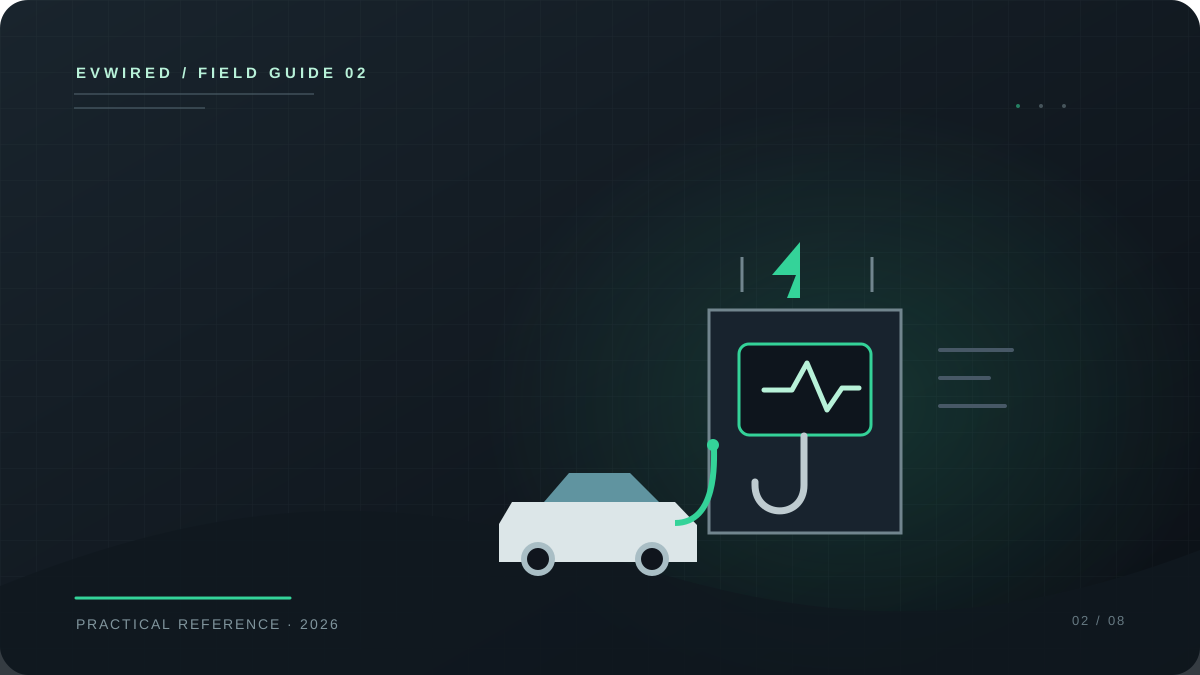
Home charging is often described in levels, but the names and electrical standards vary by region. In the United States, Level 1 commonly uses a standard household outlet and Level 2 uses higher-voltage equipment; elsewhere, domestic supply and terminology differ. The practical difference is how quickly the car can add energy and whether the circuit can support it. The U.S. Department of Energy's home charging overview explains the common U.S. categories. Always use the owner's manual and local electrical rules for the exact vehicle and property.
Estimate your need from energy added overnight, not from a theoretical empty-to-full time. If you drive a modest daily distance and the vehicle sits for many hours, slower charging may already cover the routine. A higher-power unit can be convenient for larger daily mileage or multiple drivers, but only when the vehicle accepts that power and the wiring can deliver it. The vehicle's onboard charger, circuit rating, temperature, charging losses, and current battery state can all limit the actual rate. Ask an installer and vehicle dealer to explain the limits separately.
Start with the property
Before purchasing equipment, locate the electrical panel, parking position, and likely cable route. A qualified electrician can determine whether the service panel and branch circuit have capacity, whether a new circuit is required, and whether the charger can be installed indoors or outdoors. The assessment may consider cable distance, wall material, exposure to weather, vehicle inlet position, and protection from accidental impact. Do not infer capacity from an unused breaker position alone. Local codes can require permits, inspection, specific protective devices, and work by a licensed professional.
Decide how the cable will reach the car without crossing a walkway or creating a trip hazard. A charger placed close to the panel can cost less to install, but may be awkward for two vehicles or a different parking angle. Outdoor equipment needs an appropriate rating for its environment and mounting location. Consider whether the unit can be secured, whether its controls are accessible, and whether the vehicle can be locked while connected. For attached garages, keep the area clear and follow the equipment maker's instructions for ventilation, mounting height, and cable storage.
Compare installation quotes
Ask each installer to quote the same scope: charger model, circuit rating, cable length, panel work, trenching or conduit, permits, inspection, network activation, and any expected electrical-service upgrade. Request a site visit or clearly state that the initial estimate is conditional. The cheapest quote can omit trenching, patching, or a panel upgrade that later changes the price. Confirm who obtains permits and schedules inspections, what warranty covers labor, and whether the electrician will leave a circuit diagram and documentation for future owners.
Choose hardware with recognized safety certification for your market and a support path that will remain available. Check plug and connector compatibility, cable reach, outdoor rating, load management features, and whether smart functions work without a paid subscription. If several charging loads share the electrical service, a listed load-management system may help a professional design a compliant installation; it is not a substitute for an assessment. Keep the model number, installation date, permit, inspection result, and warranty documents with the vehicle's records.
Charge safely in daily use
Use equipment designed for EV charging and follow the car and charger manuals. Avoid extension cords, improvised adapters, damaged cables, or outlets that become unusually hot. Stop using a connector if it is cracked, discolored, loose, or repeatedly interrupts charging, and have it inspected. Plug and unplug as directed rather than pulling the cable by its cord. When charging outdoors, protect connectors from standing water and physical damage according to the maker's guidance. If a breaker trips, do not repeatedly reset it without identifying the cause.
Charging to a daily limit can reduce time spent at a high state of charge for some vehicles, while the right setting depends on the chemistry and the maker's advice. Follow the manual rather than applying a universal battery rule. If the vehicle supports departure scheduling or preconditioning, set it for convenience and comfort; a plugged-in car may draw some energy from the grid instead of the pack. Periodically check the cable, wall unit, mounting, and connector for wear. Report faults through the manufacturer's support channel and use a qualified electrician for wiring problems.
Check the electricity cost
Home charging cost depends on the energy drawn from the meter, the local tariff, and charging losses. A simple estimate multiplies the added kilowatt-hours by your effective electricity price, then compares that result with the fuel a similar trip would use. Bills may have time-of-use rates, demand charges, fixed fees, taxes, or seasonal prices, so the headline price per kilowatt-hour may not represent the incremental cost. A smart charger or utility meter can help reveal when charging occurs, but confirm how its figures handle losses.
Ask the utility whether an EV-specific tariff or controlled charging plan is available, what hours qualify, and whether the plan changes prices for the rest of the home. Compare expected savings against equipment, subscription, and tariff fees. A delayed schedule is useful only if the vehicle will still be ready when needed. If solar panels or a home battery are part of the plan, calculate what exported energy would otherwise earn and whether the car can follow available generation. Energy cost varies by location, so use a recent bill and your actual driving rather than a national average.
Plan for renters and shared parking
For an apartment, condominium, or rented home, first find out who can authorize an installation and how the work would be reviewed. Ask whether the property has spare electrical capacity, whether building insurance imposes conditions, and how individual usage will be measured and billed. In shared garages, a dedicated charger may need load controls and a written access policy. Clarify who owns the equipment, who maintains it, what happens when a resident moves, and whether other drivers may use it.
If private charging is unavailable, test the public options near home, work, and regular errands before committing. Compare opening hours, reliability information, payment methods, parking rules, and typical walking distance from the charger to your destination. A route that relies on one convenient station should have a backup within reach. The AFDC guide to public charging offers a U.S. overview; local charge-point operators and transport agencies are the better source for regional connector rules and current access. Save a copy of the property decision and charging cost assumptions with your purchase research.
Sources and further reading
These primary sources support the technical and consumer information in this guide. Local requirements and model-specific details can differ.
-
Charging Electric Vehicles at Home
U.S. Department of Energy, Alternative Fuels Data Center
Common home charging equipment and charging-level context in the United States.
-
Charging Electric Vehicles in Public
U.S. Department of Energy, Alternative Fuels Data Center
Public charging options and considerations for EV drivers.
-
Electric Vehicle (EV) Consumer Guide
U.S. Department of Energy, Alternative Fuels Data Center
Consumer overview of charging and electric vehicle ownership.