America's Public Charging Network Keeps Growing
A network measured in hundreds of thousands
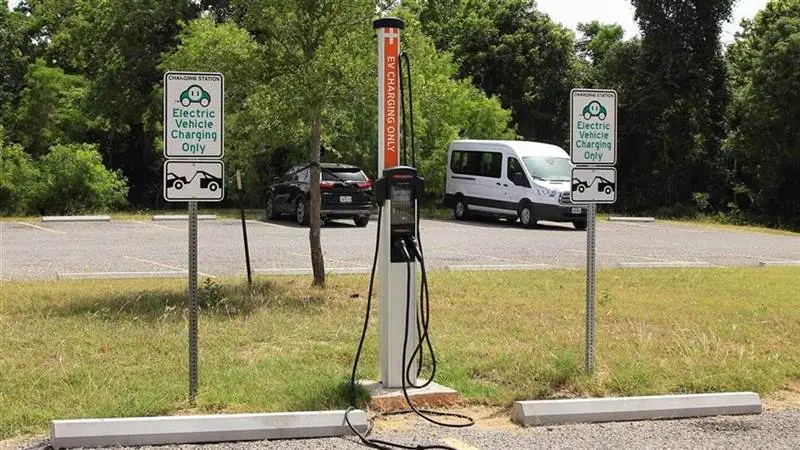
Whatever is happening in Washington, the physical build-out of America's public charging network has not stopped. The number of publicly accessible charging ports crossed 200,000 during 2025 and kept climbing: as of February 2026 the country had more than 77,000 public charging stations hosting roughly 236,000 public ports, according to federal Alternative Fuels Data Center-based counts cited in trade reporting. That is up from about 196,000 ports at the end of September 2024, per the Joint Office of Energy and Transportation — roughly 40,000 new ports in well over a year, even through a period of maximum federal turbulence.
The growth is heavily skewed toward speed. More than 18,000 new DC fast-charging ports were added in the US during 2025, an increase of roughly 30% year over year and the largest single-year fast-charging expansion on record, according to industry analyses cited by ACT News. The national DC fast-charging fleet passed 70,000 ports for the first time. Drivers planning road trips are seeing the difference first: corridor fast charging, once the network's weakest link, is now its fastest-growing segment.
NEVI: paused, sued, revived
The federal government's flagship program, the $5 billion National Electric Vehicle Infrastructure (NEVI) formula program created by the 2021 Bipartisan Infrastructure Law, spent most of that period in limbo. On February 6, 2025, the Federal Highway Administration, acting on Transportation Secretary Sean Duffy's direction, issued a memorandum suspending state deployment plans and rescinding existing NEVI guidance, freezing new obligations of funds. About $2.7 billion of the $3.3 billion appropriated to that point remained unobligated when the freeze hit.
Seventeen states plus the District of Columbia sued. In June 2025, Judge Tana Lin of the Western District of Washington granted a preliminary injunction restoring roughly $1 billion in frozen funds for the states most at risk, and on January 23, 2026 she ruled on summary judgment that the administration had acted unlawfully. Between those rulings, the Federal Highway Administration published new Interim Final NEVI Guidance, effective August 13, 2025 in the Federal Register, which formally restarted the program while dropping the old requirement that chargers sit every 50 miles along highways and giving states more flexibility on site types.
The program's real-world output remains modest relative to its budget. Government audits found 384 federally funded ports in operation as of April 2025, and by the end of 2025 NEVI-funded sites totaled 99 stations and 497 ports — only about 3% of the year's additions, according to trade reporting. Most NEVI money is only now moving as states obligate it ahead of the program's final fiscal year, with $885 million apportioned nationally for fiscal 2026.
Private money does the heavy lifting
The striking lesson of 2025 is who actually builds chargers when Washington hesitates: private networks. Companies like ChargePoint, EVgo, Electrify America and Tesla kept expanding through the freeze, and the largest annual fast-charging growth on record happened while federal obligations were essentially paused. Federal programs matter for the places the market under-serves — rural corridors, disadvantaged communities — but the economics of highway fast charging have matured enough to attract capital on their own.
NEVI's sibling program, the $2.5 billion Charging and Fueling Infrastructure discretionary grant program, continued awarding funds for community and corridor chargers throughout the dispute, and states layered their own make-ready and rebate programs on top. The result is a network whose growth no longer depends on any single funding stream — though the places private capital still avoids will feel any federal retrenchment first.
Reliability, the industry's old embarrassment, is improving too. J.D. Power's 2025 EV charging study found non-Tesla fast-charger reliability around 78%, still far short of the 97% uptime that NEVI-funded stations are contractually required to maintain, but better than the breakdown-prone networks of 2022-2023.
The Tesla effect
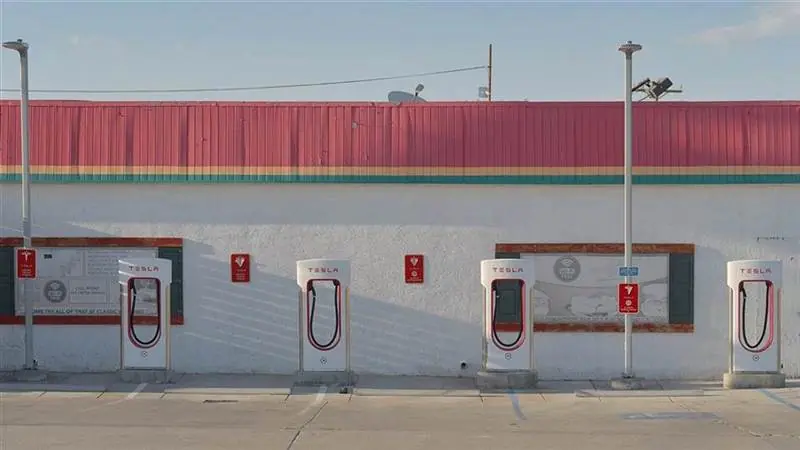
No discussion of US charging is complete without Tesla. The Supercharger network remains the country's largest and most reliable fast-charging system, and in 2025-2026 it became the industry's template: nearly every major automaker has adopted Tesla's North American Charging Standard (NACS), and formerly CCS-only networks are retrofitting NACS connectors. Automakers including GM, Ford, Hyundai and Toyota gained direct or adapter-based access to Superchargers, effectively folding the largest private network into the public one overnight.
That consolidation has a quiet benefit for the market's confidence — one plug, one payment experience — and a strategic cost: the standard everyone now builds to is owned by a competitor. It also explains part of the network's growth math, as Tesla opens Superchargers to non-Tesla vehicles and adds thousands of stalls a year.
Outlook
Charging is expanding faster than the EV fleet for the first time on record, a healthy correction after years when infrastructure lagged adoption. But the demand side just lost its $7,500 federal tax credit, and Congress has moved to claw back hundreds of millions in unspent NEVI funds. The network's trajectory through 2027 will be a live test of whether private deployment can sustain a national build-out on its own — or whether charging, like everything else in the American EV story, still depends on policy.