BYD's Megawatt Flash Charging Adds 400 km in Five Minutes
Charging at the Speed of Refueling
At a technology presentation in Shenzhen on March 17, 2025, BYD announced the Super e-Platform, an electric vehicle architecture built around the most aggressive charging claim ever attached to a production car: one megawatt of peak charging power, enough to add around 400 kilometers of range in five minutes. Chairman Wang Chuanfu framed the goal bluntly at the launch, saying the pursuit was to make EV charging as fast as refueling a gasoline car, achieving what BYD calls equal speed for charging and fueling.
The numbers, according to BYD's announcement, work out to a peak rate of two kilometers of range per second during a flash-charging session. Even allowing for the usual caveats about peak versus average power, that is a step change: the fastest production EVs before this platform topped out around 350 to 400 kW, while BYD's system doubles the most powerful chargers on the market.
A 1,000-Volt Everything Platform
The Super e-Platform is described by BYD as the world's first mass-produced passenger car platform with an all-domain 1,000-volt high-voltage architecture. That phrase means the battery, electric motor, power electronics and even the air conditioning system all operate at the kilovolt level, rather than stepping voltage down between subsystems. Higher voltage at the same current delivers more power, and spreading the architecture across the whole car avoids the conversion losses and bottlenecks of partial upgrades.
Handling that voltage required new silicon. BYD says it has developed and begun mass production of a new generation of automotive-grade silicon carbide power chips rated at 1,500 volts, which it describes as the highest voltage class ever mass-produced for vehicles. The chips sit at the heart of the inverter and charging system, switching the enormous currents involved with minimal loss.
The Flash Charging Battery
The enabling cell is BYD's flash charging battery, a new entry in the company's blade-shaped lithium iron phosphate family. According to BYD, ultra-fast ion channels built from the cathode through to the anode cut the battery's internal resistance by half, allowing a charging current of 1,000 amperes and a charging rate of 10C, meaning the pack could theoretically take its full capacity in about six minutes. Both figures, the company says, are unprecedented in mass-produced EV batteries.
LFP chemistry matters here. It is inherently more thermally stable than the high-nickel chemistries used in many fast-charging packs, and BYD's blade form factor has already passed the company's much-publicized nail penetration demonstrations. Reports on the launch noted that the battery held charging power up to around 600 kW even at a 90 percent state of charge, which would make real-world sessions far quicker than the peak figure alone suggests.
Stations to Match the Cars
A megawatt car is useless on a 150 kW charger, so BYD unveiled the infrastructure side at the same event. Executive vice president Lian Yubo introduced the world's first fully liquid-cooled megawatt flash-charging terminal system, with a maximum output capability of 1,360 kilowatts, and said BYD plans to build more than 4,000 megawatt flash-charging stations across China.
Two compatibility tricks extend the system beyond BYD's own stations. Dual-gun charging lets a vehicle draw from two standard dispensers simultaneously, turning ordinary fast-charging stalls into near-flash installations, while a smart voltage-boosting feature makes the platform compatible with existing public fast chargers. BYD's pitch is that the car can drink from whatever is available, and simply drinks faster when the hardware allows.
Han L and Tang L: The Launch Vehicles
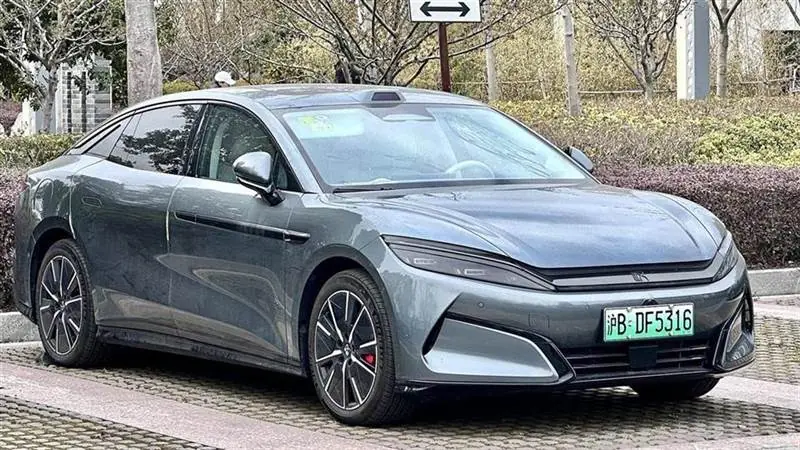
The first models on the platform are the flagship Han L sedan and Tang L SUV, which opened pre-sales at the March event with prices of 270,000 to 350,000 yuan for the Han L EV and 280,000 to 360,000 yuan for the Tang L EV, ahead of April 2025 market launches. Both pair the flash-charging battery with motors that redefine the segment's performance ceiling.
BYD says the platform's rear motor spins at more than 30,000 revolutions per minute, a figure it calls the highest in any mass-produced EV, with a single motor module delivering up to 580 kilowatts and top speeds exceeding 300 kilometers per hour. Performance variants of the two flagships combine front and rear motors for a combined output reported at around 1,100 horsepower, putting them among the quickest accelerating production cars ever built. Alongside the electric versions, Han L and Tang L plug-in hybrid variants with BYD's DM-p technology opened blind orders at the same event, giving buyers a stepping stone while the flash-charging network fills in.
How Far Ahead Is BYD?
Perspective makes the leap obvious. Most public DC fast chargers deliver 150 to 350 kilowatts and add roughly 150 to 250 kilometers in twenty minutes, while Tesla's latest V4 Superchargers top out around half of BYD's peak power. Autocar India, covering the launch, calculated that BYD's system delivers about twice the charging speed of Tesla's newest hardware, and several times the practical throughput of a typical highway charger.
The relevant comparison, though, is not other chargers but fuel pumps. BYD noted at the launch that a gasoline car spends five to eight minutes at the pump, and a Han L with a flash-charging battery can match that stop for a similar stretch of range. That is the psychological threshold the whole industry has been chasing, and BYD reached it first, at least within China.
What Megawatt Charging Changes
If the infrastructure rollout keeps pace, five-minute charging erodes one of the last structural advantages of combustion cars. Fleet operators can turn vehicles around at meal stops, highway rest areas can serve more cars per charger per hour, and range anxiety gives way to the same mental model drivers apply to fuel tanks today.
The caveats are real: megawatt sessions demand serious grid connections and sophisticated liquid cooling, and most of the world's charging networks will not reach these speeds for years. BYD's deployment is initially confined to China, where it controls both the cars and the stations. But as a demonstration of the possible, BYD's Super e-Platform sets the pace for the industry. Charging is no longer the slow part of an electric road trip, and every competitor now has to answer the megawatt question.