Kia EV4 Arrives as the Brand's First Global Electric Sedan
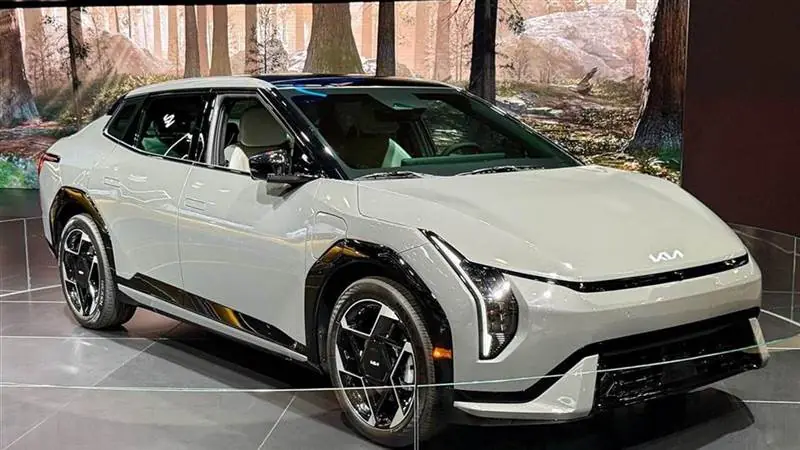
Kia's electric lineup breaks the SUV mold
Kia introduced the production EV4 sedan and hatchback at its EV Day in Tarragona, Spain, on February 27, 2025, according to Hyundai Motor Group's announcement. The two body styles extend the brand's dedicated electric range into the compact passenger-car segment, alongside its existing crossovers and SUVs. Market introductions followed on different schedules; the event date should not be treated as a worldwide on-sale date. The useful distinction for a buyer is whether the local offering is the five-door hatchback or the longer four-door fastback, since luggage access, dimensions and range differ.
The design follows Kia's Opposites United philosophy, with vertical headlamps pushed to the edges of the hood, an EV Tiger Face front end and a distinctive upright targa-style C-pillar on the hatchback. The fastback variant stretches the tail for a sleeker silhouette and, according to Kia, top-class aerodynamics in the class. Recognition has followed: the EV4 won the Family Car category at the 2026 UK Car of the Year Awards.
Batteries, range and charging
Two battery sizes anchor the range. European models offer a 58.3 kWh standard pack and an 81.4 kWh long-range pack, both feeding a single permanent-magnet motor driving the front wheels with 150 kW, or about 201 horsepower, and 209 pound-feet of torque, per Kia's published specifications. All-wheel drive is not offered at launch, though Kia has hinted a dual-motor version could come later.
Kia's European specifications list up to 625 kilometers WLTP for the long-range hatchback and 633 kilometers for the fastback, depending on equipment and market. The hatchback figure is approximately 388 miles by unit conversion; it is not an EPA range rating or a forecast for a US version. The EV4 uses a 400-volt architecture. Kia's September 2025 German press specifications give peak DC charging of 128 kW for the 81.4 kWh battery and 101 kW for the 58.3 kWh battery, with respective 10-to-80-percent charging times of about 31 and 29 minutes under stated conditions. A station's advertised output is not the vehicle's charging limit.
Built on familiar foundations
Underneath, the EV4 uses the 400-volt version of the group's E-GMP architecture rather than the 800-volt arrangement used by some larger models. Kia's launch announcement specifies an 11 kW onboard AC charger. Equipment such as a heat pump and assistance packages needs to be checked against the local trim list rather than assumed standard everywhere. Buyers planning regular motorway trips should compare the charging window and battery-preconditioning instructions, not voltage alone. At home, available supply and parking access may matter more than the difference between the two battery sizes' DC peak figures.
Cabin and technology
Inside, the EV4 gets Kia's wide panoramic display, a curved screen combining a 12.3-inch instrument cluster, a 5-inch center strip and a 12.3-inch infotainment panel into roughly 30 inches of glassware. A column-mounted shifter, two- or three-spoke steering wheels depending on trim, and extensive ambient lighting give the cabin a distinct identity. Higher trims add ventilated and relaxation front seats, a Harman Kardon audio system, a head-up display and a smart power tailgate.
Kia lists luggage capacity of 435 liters for the hatchback and 490 liters for the fastback in the European specifications reviewed here. The larger number does not settle which body is more useful: a hatchback's opening may suit bulky objects better, while a separate boot can suit other needs. Vehicle-to-load availability, driver-assistance packages and their operating limits should be confirmed for the exact trim. A demonstration of the rear-seat folding arrangement and a check with a familiar pushchair or suitcase can be more informative than a class-leading marketing claim.
Compare prices within the same market
A price quoted in one country should not be presented as another country's starting price. Kia's July 2025 German pricing announcement listed a 37,590-euro entry price for the EV4 with a 58.3 kWh battery; that dated figure is a reference for the launch offering, not a promise of today's dealer transaction price. Compare battery, body style, trim, mandatory charges and tax treatment within the same national price list. An Austrian euro price or a Canadian dollar price cannot establish what a German shopper will pay, even where the model names look identical.
Notably, Kia has so far chosen not to offer the EV4 in the United States, according to Driving.ca, even though the car made its North American public debut at the 2025 New York International Auto Show. That decision leaves US buyers without Kia's most affordable global EV, while Canadian and European shoppers get a compact electric car that undercuts the Tesla Model 3 on price in several trims.
What the EV4 means for Kia
Strategically, the EV4 fills the gap between the small EV3 and the larger EV5, EV6 and EV9, and it gives Kia a genuine rival to the Tesla Model 3, Hyundai Ioniq 6 and Volkswagen ID.3-family cars in the segments where EV adoption is growing fastest in Europe and Asia. Its efficiency, long range and conventional driving manners, reviewers note that it feels like a normal, well-sorted compact car rather than an experiment, should help it reach mainstream buyers rather than enthusiasts.
A useful comparison starts with three checks: the same test cycle for range, the same battery window for charging time, and a local price for comparable equipment. Then consider the practical difference between the hatchback and fastback. Neither a WLTP label nor an advertised maximum charging rate guarantees a particular motorway journey. The EV4 broadens Kia's passenger-car offering, but its value for a household depends on those specific comparisons and on whether the required version is actually available locally.