The 2026 Nissan Leaf Returns as a 303-Mile Crossover
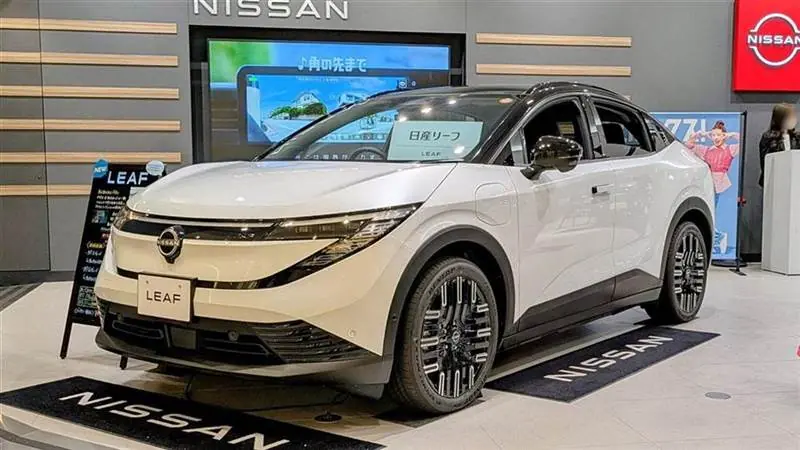
The pioneer returns as a crossover
When Nissan launched the original Leaf in 2010, it became the first mass-market electric car from an established automaker, and it went on to cover more than 18 billion miles worldwide, according to Nissan. The 2026 Leaf, the nameplate's third generation, abandons the humble hatchback shape in favor of a sleek crossover silhouette that the company says blends a coupé-like roofline with a confident SUV stance. The new car was first shown globally in June 2025 and reached U.S. dealerships in the fall of 2025 as a 2026 model.
The redesign is more than cosmetic. Nissan's designers gave the new Leaf motorized flush door handles, a first for a production Nissan, and a roofline that carries a katana blade element inspired by the Z sports car. A dimming panoramic roof, which switches between opaque and transparent at the touch of a button, is described by Nissan as a segment first. The overall look is cleaner and more aerodynamic than the car it replaces, and it finally resembles something a buyer in 2026 would choose on style alone rather than as an environmental statement.
Up to 303 miles of EPA range
The headline number is range. In S+ trim with the 75 kWh battery, the 2026 Leaf carries an EPA-estimated 303 miles per charge, with EPA figures of 131 MPGe city and 111 MPGe highway, according to Nissan. Higher trims trade some of that efficiency for equipment and wheels: the SV+ is rated at 288 miles and the top Platinum+ at 259 miles. Even the lowest of those figures would have been unthinkable in a Leaf a few years ago.
Battery options differ by market. Overseas buyers can choose an entry battery of roughly 52 kWh, while U.S.-market cars all use the larger 75 kWh pack. Nissan quotes a peak DC fast-charge session of about 35 minutes, and the 75 kWh S+ takes 6.5 hours for a full charge on 240-volt home power, per the company's specification sheet. Those numbers put the Leaf squarely in the mainstream of affordable electric cars rather than at the back of the pack, where its predecessor had slipped.
A native NACS port changes everything
Perhaps the biggest practical upgrade hides behind the charging port flap. The third-generation Leaf is Nissan's first with a built-in North American Charging Standard (NACS) port alongside a J1772 connector for Level 1 and Level 2 charging, which means drivers can use Tesla's Supercharger network without an adapter. Nissan says Plug and Charge capability provides seamless access to more than 20,000 Superchargers at launch, a figure the company later revised upward to more than 27,500 stations.
That single change addresses one of the longest-standing criticisms of the original Leaf, which relied on the CHAdeMO fast-charging standard and was effectively locked out of the fastest public charging in North America. For a car whose early adopters tolerated exactly this kind of compromise, the ability to pull up to almost any Supercharger and start charging automatically is a quiet revolution.
Pricing that undercuts the original
Despite the extra range and hardware, the 2026 Leaf costs less than its ancestor did in 2011. Nissan set the starting MSRP for the S+ grade at $29,990, which the company bills as the lowest starting price of any new EV on sale in the United States at the time of its August 2025 pricing announcement. The original 2011 Leaf listed for $32,780, so the new car delivers dramatically more capability for roughly $2,800 less.
- Leaf S+ at $29,990, with dual 12.3-inch widescreen displays and ProPILOT Assist
- Leaf SV+ at $34,230, adding dual 14.3-inch displays, Google built-in and aluminum-alloy wheels
- Leaf Platinum+ at $38,990, with the dimming panoramic roof and a Bose Personal Plus audio system
All three grades are front-wheel drive and share the 75 kWh battery, so the choice comes down to features rather than driving range. Nissan's stated goal, in the words of U.S. marketing chief Vinay Shahani, has been to keep the Leaf's price steady across three generations while giving owners more style, more technology and far more range.
A cabin built around screens and cameras
Inside, the new Leaf leans hard into technology. Upper trims carry dual 14.3-inch widescreen displays with Google built-in, including Google Maps and an Intelligent Route Planner that factors charging stops into navigation. The S+ makes do with 12.3-inch screens, but every Leaf gets a suite of camera-based aids that Nissan reserves for this class: a standard Intelligent Around View Monitor, plus Invisible Hood View and Front Wide View functions that let the driver peer over obstacles and around blind corners.
There are physical comforts, too. Redesigned seats free up second-row knee room, the floor under the dashboard is completely flat, and 64-color ambient lighting lets owners tune the cabin's mood. The Available features list also includes the dimming panoramic roof and a wireless charger, equipment that would have seemed absurd in the spartan first-generation car.
Awards and early reception
The market has responded. The 2026 Leaf was named Best Car of 2026 by Cars.com, took the top spot in Car and Driver's ranking of electric subcompact SUVs, and was named Best Subcompact Electric SUV in the U.S. News 2026 Best Hybrid and Electric Car Awards. It also made the WardsAuto 10 Best Engines and Propulsion Systems list and finished as a finalist for the North American Utility Vehicle of the Year award, according to Nissan's award roundup.
European buyers get the same car with different tuning: production for that market is handled at Nissan's Sunderland plant in England, and British sales began in 2026, according to Autocar, which notes UK prices start well below the equivalent of the larger-battery competition.
What the new Leaf means for the market
The third-generation Leaf matters because it attacks the heart of the EV market from below. A 303-mile crossover with native Supercharger access and a sub-$30,000 entry price undercuts the least expensive versions of the Tesla Model Y and puts pressure on the Chevrolet Equinox EV and Kia's smaller electric models. Nissan, which once defined the affordable EV and then watched Tesla take the crown, has finally fielded a car that can compete on range, charging, price and desirability all at once.
Whether it regains the sales leadership the original once enjoyed is another question, but for the first time in a decade the answer depends on the car itself rather than on its compromises.