A US Battery Manufacturing Boom Takes Shape
A battery belt takes shape
American lithium-ion battery manufacturing has quietly become one of the largest industrial buildouts in the country. Driven by electric vehicle demand and by federal production credits under Section 45X of the Inflation Reduction Act — which pays manufacturers 35 dollars per kilowatt-hour for finished cells and 10 dollars per kilowatt-hour for modules, according to the US Treasury — automakers and battery makers have committed tens of billions of dollars to factories across the Midwest, the South and the Plains. The result is a map dotted with plants that together represent several hundred gigawatt-hours of announced annual cell capacity.
The projects differ in chemistry, customer and pace, but they share a logic: cell production is migrating to the same continent as vehicle assembly. That shortens supply chains, satisfies domestic-content rules and, for a time, made the economics of US cell production genuinely attractive. A tour of the flagship plants shows how far the buildout has come — and how uneven the finish is proving.
The GM and LG joint ventures
The most mature story belongs to Ultium Cells, the joint venture between General Motors and LG Energy Solution. Its first plant in Warren, Ohio, spans 2.8 million square feet and began cell production in August 2022. According to Ultium Cells, the site now employs about 2,200 workers, has an annual production capacity of more than 45 gigawatt-hours, and produced its 100 millionth cell in December 2024. The pouch-style nickel-cobalt-manganese-aluminum cells feed GM's electric trucks and SUVs.
A second Ultium plant in Spring Hill, Tennessee, started production in February 2024 and lists a similar capacity of more than 45 gigawatt-hours with roughly 1,350 employees, per the joint venture. In July 2025 the partners announced that Spring Hill would be upgraded to produce lower-cost lithium iron phosphate cells by late 2027, a nod to the industry's shift toward cheaper chemistries as price competition intensifies.
Ford's BlueOval SK campus
Ford and SK On's BlueOval SK venture has built the single largest new manufacturing site in Kentucky's history. The BlueOval SK Battery Park in Hardin County represents an investment of about 5.8 billion dollars and, according to Kentucky economic development filings, is planned for roughly 86 gigawatt-hours of annual capacity with about 5,000 jobs once fully built out — a scale its developers have described as among the largest battery plants in the world. A companion BlueOval SK plant in Tennessee is sized at about 43 gigawatt-hours.
Production there began serving Ford's electric F-150 Lightning and E-Transit lines, though Ford has throttled some EV output as demand softened, a reminder that gigawatt-hours announced are not always gigawatt-hours sold.
Panasonic, Toyota and LG scale up
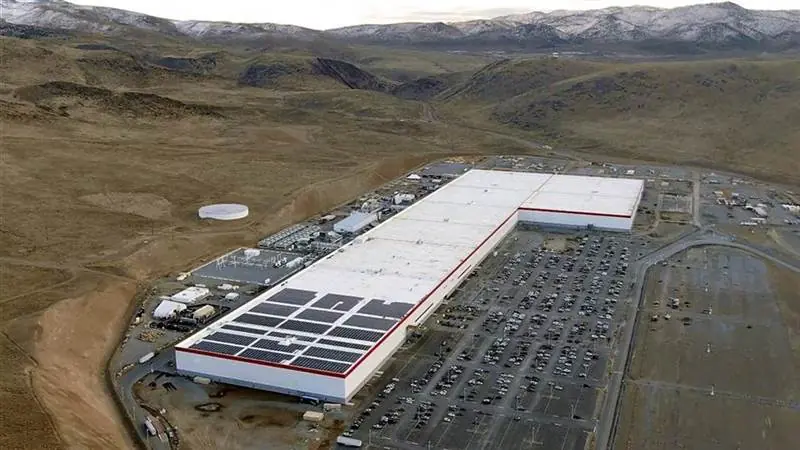
Panasonic Energy officially opened its second North American cell factory in De Soto, Kansas, on July 14, 2025, targeting an annual capacity of about 32 gigawatt-hours and up to 4,000 jobs. The company calls it the largest private investment in Kansas history, and together with its long-running Nevada plant — which has produced more than 11 billion cells since 2017 and runs at about 41 gigawatt-hours — Panasonic's US footprint reaches roughly 73 gigawatt-hours, according to the company.
Toyota joined the club in November 2025, when production began at its battery plant in Liberty, North Carolina. Per Toyota, the nearly 14 billion dollar facility is the company's first battery plant outside Japan, with 14 production lines and the ability to make about 30 gigawatt-hours annually at full capacity, employing up to 5,100 people. The site initially ships hybrid battery modules to Toyota's Kentucky plant and to the Mazda-Toyota joint venture in Alabama, with additional lines due by 2030.
LG Energy Solution, already the largest battery maker in North America by some measures, has converted lines at its Holland, Michigan plant to roughly 17 gigawatt-hours of lithium iron phosphate output for energy storage, and its new Lansing plant — sized for more than 35 gigawatt-hours at full scale — is slated to begin production later in 2026, according to the company.
Headwinds behind the boom
The boom is real, but so are the strains. Federal support shifted after the One Big Beautiful Bill Act of 2025 ended consumer EV tax credits and tightened sourcing rules, softening demand forecasts for battery-electric vehicles even as 45X production credits survived. Several operators have pivoted part of their capacity toward grid-scale storage cells, a market growing fast enough to absorb some of the slack; LG's Holland conversion is the clearest example. Analysts also caution that announced capacity includes projects that may be delayed, downsized or repurposed before they ever run at nameplate rates.
There are bright spots beneath the uncertainty. Cell costs keep falling, LFP chemistry reduces dependence on nickel and cobalt, and the plants now operating give the United States something it lacked five years ago: a functioning domestic cell industry with trained workforces and proven lines.
Why the boom still matters
Even at reduced EV growth rates, the strategic value of the buildout is unchanged. Batteries are the most valuable component of an electric vehicle, and the factories now running in Ohio, Tennessee, Kentucky, Michigan, Kansas and North Carolina anchor a supply chain that previously ran almost entirely through Asia. Whatever the demand curve does next, the map of American advanced manufacturing has been redrawn — one gigafactory at a time.