Hyundai Ioniq 5 Refresh Adds Range and a Tesla-Style Port
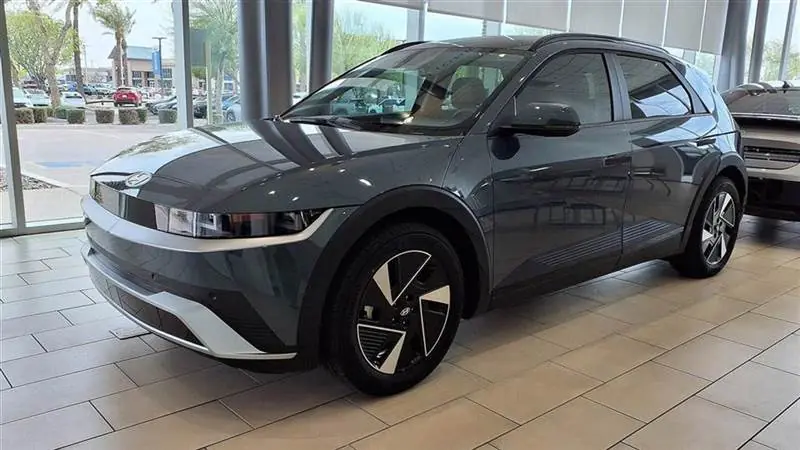
A quiet overhaul for an award winner
The Ioniq 5 has carried Hyundai's electric ambitions since it arrived as a 2022 model and took the World Car of the Year title that year. By 2024 it was the brand's best-selling EV, but two of its original drawbacks were becoming harder to ignore: real-world range that trailed newer rivals, and a CCS charge port just as the American market pivoted to Tesla's connector. Hyundai's answer arrived with the refreshed Ioniq 5, unveiled for North America on September 3, 2024 and on sale from late that year as a 2025 model, with the same formula carrying into the 2026 model year with only minor changes.
Because the update ran through the 2026 model year, the changes now define every mainstream Ioniq 5 on the lot: a bigger battery, a Tesla-compatible charge port, revised styling and, for the first time, United States production. It is the kind of mid-cycle refresh that changes a car's competitive position more than many full redesigns.
A bigger battery and more range
The heart of the update is battery capacity. Long-range versions grew from 77.4 kWh to 84.0 kWh, while standard-range packs went from 58.0 kWh to 63.0 kWh, according to Hyundai's specifications. The payoff shows in the EPA numbers: the SE, SEL and Limited rear-wheel-drive trims now deliver an EPA-estimated 318 miles of range, up from 303 miles, per Hyundai's November 2024 pricing and range announcement. The standard-range SE RWD improved from 220 to 245 miles, all-wheel-drive SE and SEL trims reached 290 miles, the Limited AWD 269 miles, and the new XRT 259 miles.
Pricing started at 43,975 dollars including destination for the SE RWD Standard Range, per Hyundai's announcement. The 800-volt electrical architecture that made the original Ioniq 5 famous for charging speed carried over: Hyundai says the long-range rear-drive car can go from 10 to 80 percent in about 20 minutes on a 350-kW charger, and add up to 178 miles in roughly 15 minutes, while remaining backward compatible with older 400-volt infrastructure.
The Tesla-style port changes everything
The single most consequential change sits behind a small door: the 2025 Ioniq 5 became the first Hyundai with a native North American Charging Standard port, the Tesla-designed connector now standardized as SAE J3400. That gives drivers access to more than 17,000 Tesla Supercharger stalls across North America without an adapter, roughly doubling the DC fast-charging network available to the car, according to Hyundai. A CCS adapter ships as standard equipment, preserving access to the legacy networks, and Hyundai says the combined setup opens up about 36,000 NACS and CCS fast chargers.
Hyundai timed the switch carefully. With nearly every major automaker committed to NACS, the adapter era was ending, and the Ioniq 5 became one of the first non-Tesla EVs to make the transition natively rather than through an add-on. For buyers, road trips get simpler: Supercharger reliability and coverage now come as standard, and the car's strong 800-volt charging speed remains available at 350-kW stations via the included adapter. The high-performance Ioniq 5 N also moved to the native NACS port for the 2026 model year, per Hyundai.
New looks and an adventure trim
Visually, the refresh is subtle but welcome. Restyled front and rear bumpers emphasize the SUV stance, a new rear spoiler and more aerodynamic wheels help efficiency, and the lineup finally gained a rear wiper, a small feature owners had requested since launch. New matte paint options and flush roof rails round out the changes, per Hyundai's release.
The bigger news was the XRT, a new adventure-oriented trim with a 23-millimeter suspension lift, all-terrain tires, underbody styling, a Snow-Sand-Mud Terrain Mode selector and 7.0 inches of ground clearance versus 6.1 inches for the standard car, according to Hyundai. It gives the Ioniq 5 a genuine off-road-flavored variant to match rivals, and it arrived as one of the most visible ways to spot the updated car on the road.
Built in Georgia
The refresh coincided with a manufacturing milestone. The Ioniq 5 was the first vehicle built at Hyundai Motor Group Metaplant America, the company's new plant in Ellabell near Savannah, Georgia, where the first car, a white 2025 SEL, rolled off the line on October 3, 2024, according to Hyundai. The 12.6-billion-dollar Georgia investment is the largest economic development project in the state's history, per Hyundai, with initial capacity of 300,000 vehicles a year planned to grow to 500,000.
US production had immediate consequences for buyers: models built at the Metaplant qualified for a 3,750-dollar federal purchase tax credit at launch, with leased cars eligible for 7,500 dollars, per Hyundai's announcement. The federal EV credit has since ended, but local production still matters for pricing stability and supply, and the Georgia plant now also builds the three-row Ioniq 9 alongside the Ioniq 5.
Still the benchmark for charging
With the update, the Ioniq 5 fixed its two biggest gaps at a stroke. Range now sits near the front of the compact electric SUV class, and the native NACS port removed the last practical argument against the car for road-trip-heavy buyers, while the 800-volt architecture keeps it among the fastest-charging EVs of any price. Add US production, an expanded lineup capped by the 601-horsepower Ioniq 5 N, and styling that still turns heads three years in, and the refreshed Ioniq 5 re-entered 2026 as one of the most complete electric SUVs on the American market.