Vehicle-to-Grid Pilots Start Paying EV Owners for Power
From Backup Power to Grid Revenue
Most electric cars spend more than 90 percent of their lives parked, and a growing set of pilots wants to turn that idle capacity into income. Vehicle-to-grid, or V2G, lets an EV discharge power back to the utility during moments of peak demand, in exchange for bill credits or direct payments. It sits at the most demanding end of the bidirectional-charging spectrum, beyond vehicle-to-load gadgets and vehicle-to-home backup, because the electricity must flow back onto a regulated network under utility control.
The economics are straightforward on paper. A long-range EV carries enough energy to run a typical home for days, and utilities desperately need that flexibility on the hottest summer afternoons, when peaker plants set the marginal price of electricity. What has changed in the past two years is that real programs, with real dollar figures attached, have moved from press releases to customer invoices.
Ford Proved the Concept at Home
The highest-profile demonstration began with a pickup truck. Ford's Intelligent Backup Power launched alongside the F-150 Lightning in 2022 and remains the reference point for vehicle-to-home capability in the United States. With an 80-amp Ford Charge Station Pro and a Home Integration System installed by solar partner Sunrun, the truck can supply up to 9.6 kilowatts to a house during an outage. Ford says a fully charged extended-range Lightning, with its roughly 131-kilowatt-hour pack, can power an average home for up to 10 days when consumption is rationed, and around three days without rationing.
Strictly speaking, that system is vehicle-to-home rather than V2G, because it islands the house from the grid. But it proved the hardware case, and derivatives of the same truck now participate in true grid pilots. In Baltimore, a program involving Ford F-150 Lightning trucks, Sunrun, and utility Baltimore Gas and Electric expanded in 2025 to grid-parallel exports, paying participants for discharging during weekday evening peaks, with annual payments capped at 1,000 dollars, according to a research report prepared for the Massachusetts Clean Energy Center.
The Nissan Leaf Ran the Longest Pilots
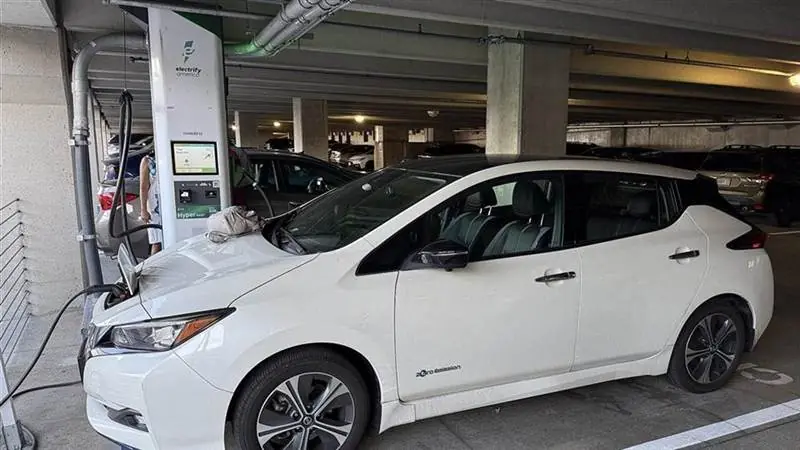
The Leaf is the veteran here. Nissan's hatchback became the first fully bidirectional-capable electric vehicle launched in the United States in 2013, and its CHAdeMO port has anchored V2G research ever since. Fermata Energy's FE-15 and later FE-20 chargers, both Nissan-approved, let parked Leafs sell peak-shaving services to buildings and grids; in a proof-of-concept trial at Nissan's Americas headquarters in Franklin, Tennessee, the FE-15 helped cut electricity bills by more than 9,450 dollars over four years, or nearly 2,000 dollars a year on average, according to Nissan.
The company has since industrialized the lesson. Nissan says it has accumulated more than forty V2G pilot projects in a decade, including a partnership with Nuvve on one of the world's first commercial V2G hubs in Denmark, and in 2026 announced real V2G deployment in the United Kingdom after obtaining the first G99 grid-certification for an automaker's AC bidirectional architecture. UK trial participation is tied to smart tariffs from Octopus Energy and OVO that pay for exported power at time-of-day rates, per reports on the program.
School Buses Become Power Plants
Electric school buses may be the most natural V2G fleet of all. They follow fixed routes, charge predictably overnight, and sit idle through the summer, exactly when grid stress peaks. According to the World Resources Institute, at least 26 utilities across 19 US states had enacted electric school bus V2G programs as of May 2025, up from 11 utilities and five states two years earlier.
The best-documented case is Beverly, Massachusetts, where operator Highland Electric Fleets works with utility National Grid's ConnectedSolutions demand-response program. The utility pays for power delivered during peak events, with qualifying performance earning up to 200 dollars per kilowatt per season, and Highland reports average annual payments of roughly 9,000 dollars per bus. The MassCEC report also notes the Boston-area program's sister case in Maryland, where new state interconnection rules now formalize how residential V2G systems hook into the distribution grid.
Getting Paid: The Early Numbers
Residential payments are arriving too. Massachusetts' ConnectedSolutions program, run by Eversource and National Grid, has expanded from thermostats and home batteries to electric vehicles: enrolled EV owners receive 275 dollars per kilowatt for their average contribution during the summer peak season, according to program materials, with a MassCEC demonstration supplying free bidirectional chargers to participants. Eligible vehicles include the Nissan Leaf, Ford F-150 Lightning, Kia EV9, Polestar 3, and Volvo EX90.
Britain's trials show the same pattern, with export tariffs paying participating EV owners per kilowatt-hour pushed back during evening peaks. None of this makes anyone rich; payments in most pilots range from a few hundred to a few thousand dollars a year. But the direction of travel is unmistakable.
The Barriers Between Pilots and Paychecks
Friction remains. Bidirectional hardware and installation cost several thousand dollars at minimum, and Efficiency Vermont's December 2024 market study put complete residential V2X systems at around 10,000 dollars as of late 2024. Interconnection approvals are slow, communication standards such as IEEE 2030.5 and UL 1741-SA certification are still settling, and some automakers restrict how much energy buyers may export under warranty terms.
Yet the pilots have crossed a threshold: compensation is no longer theoretical. The vehicles are becoming storage plants that happen to have wheels, and the utilities, regulators, and fleet operators who build the accounting rules first will define what a parked EV is worth.