Why 800-Volt Architectures Make EV Charging Faster
The Physics Behind the Speed
Charging power is the product of voltage and current. A conventional 400-volt EV pushing 150 kilowatts into its battery must move about 375 amperes through its cables and connectors, because every amp generates heat in proportion to the square of the current. Double the system voltage to 800 volts and the same 150 kilowatts needs less than 190 amperes. Halve the current and resistive losses fall to roughly a quarter, which means thinner copper cables, lighter harnesses, cooler connectors, and far less waste heat to manage inside the pack.
That trade-off is why nearly every serious fast-charging effort of the past few years has converged on high voltage rather than ever-higher current. Four-hundred-volt platforms tend to flatten out somewhere between 150 and 250 kilowatts, both because of cable limits and because the battery itself resists accepting enormous currents. An 800-volt architecture attacks the problem at its source, letting charge rates climb to 250, 350, and now, in the newest Chinese platforms, beyond one megawatt, while keeping components within manageable thermal limits.
Porsche Set the Standard
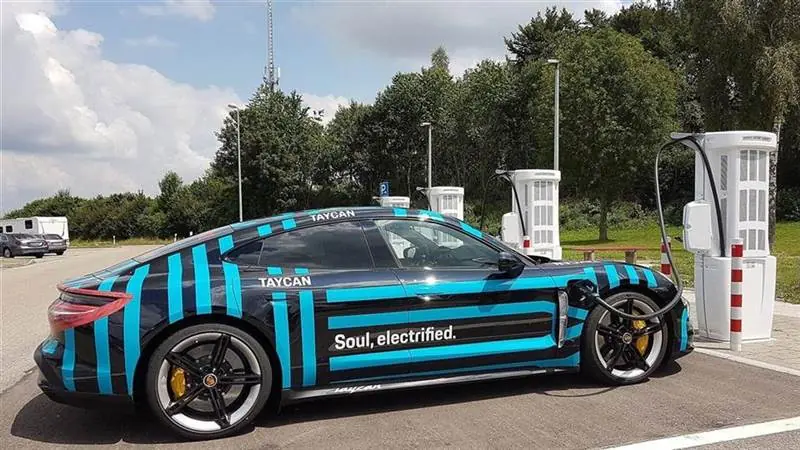
The first production car to prove the concept arrived in September 2019. According to Porsche's Newsroom, the Taycan was the first production vehicle with an 800-volt system instead of the roughly 400 volts usual for electric cars, a decision Porsche said shortened charging times and saved weight. Fitted with the 93.4-kilowatt-hour Performance Battery Plus, the Taycan peaked at 270 kilowatts on DC fast chargers, could recover about 100 kilometers of range in roughly five minutes, and charged from 5 to 80 percent in 22.5 minutes under ideal conditions.
Porsche has kept refining the formula. The current generation of the Taycan can take up to 320 kilowatts at an 800-volt station and, per Porsche's own guidance, charges from 10 to 80 percent in about 18 minutes. The message from Zuffenhausen was clear: high voltage is not a lab curiosity but a repeatable, production-ready advantage.
Hyundai's E-GMP Brings It to the Mainstream
What Porsche did for sports cars, Hyundai's Electric-Global Modular Platform did for the family crossover. The Ioniq 5, the first vehicle on E-GMP, carries an 800-volt battery system that Hyundai says charges from 10 to 80 percent in 18 minutes at a 350-kilowatt DC station, adding roughly 100 kilometers of range in five minutes for the long-range version. Kia's EV6 and Genesis' GV60 and G80 Electric share the same foundation, making 800-volt charging a mass-market feature rather than an exotic option.
Cleverly, E-GMP also solves the infrastructure chicken-and-egg problem. Hyundai's multi-charging system, which the company describes as a world-first patented technology, uses the drive motor's inverter to boost a 400-volt supply up to the battery's 800 volts, so the car can use both generations of public chargers without extra adapters or add-on components. The vehicle, not the charger, handles the voltage conversion, which keeps early adopters from being stranded in front of legacy hardware.
BYD Pushes Past 1,000 Volts
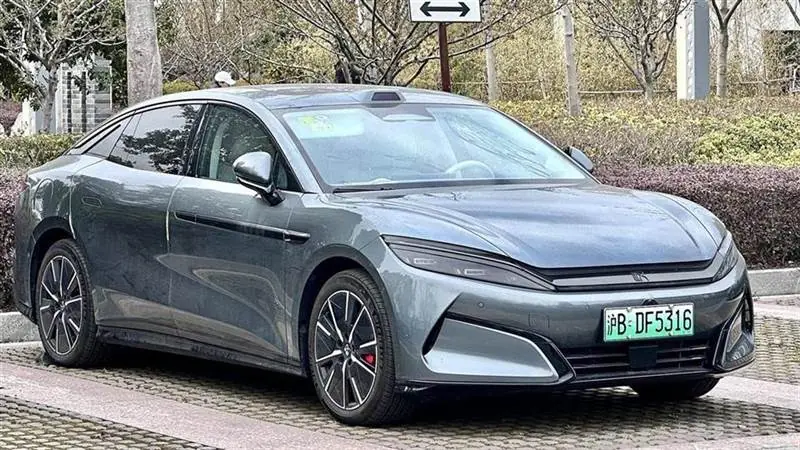
In March 2025, BYD raised the ceiling again with its Super e-Platform, described by the company as the world's first mass-produced passenger-car platform with an all-domain kilovolt high-voltage architecture. Battery, motor, power electronics, and air conditioning all run at 1,000 volts. The Flash Charging Battery accepts up to 1,000 amperes at a 10C rate, and BYD claims a peak charging power of one megawatt, adding up to 400 kilometers of range in five minutes on its own hardware, which it rates at a maximum output of 1,360 kilowatts.
The supporting silicon matters as much as the headline numbers. BYD mass-produced a new generation of automotive-grade silicon carbide power chips rated at 1,500 volts to make the architecture possible, and said it planned thousands of megawatt-class charging stations across China. A second-generation Blade battery announced in March 2026 pushes the claims further, targeting a 10-to-70-percent charge in five minutes with hardware rated up to 1,500 kilowatts, though those figures require compatible vehicles and dedicated stations.
What It Means for Buyers
The practical difference shows up on road trips. A 400-volt EV that peaks at 150 kilowatts typically needs 30 to 45 minutes to charge from 10 to 80 percent, while an 800-volt vehicle at a capable station completes the same job in under 20 minutes, close to the rhythm of a conventional fuel stop. Lower heat also means the pack needs less aggressive cooling during charging, which preserves both battery life and consistent performance back to back.
The catch remains infrastructure. High-voltage cars charge fastest only where 800-volt or higher hardware exists, and preconditioning software that warms the battery en route to a charger is now essential to hit published times. Even so, the direction is settled: with Porsche, Hyundai, Kia, Genesis, BYD, and a growing list of others committed to high-voltage platforms, the mainstream EV is being rebuilt around the idea that stopping should take minutes, not half an hour.