Xiaomi SU7: How a Phone Maker Shook Up the EV World
A phone maker announces it will build cars
When Lei Jun, the founder and chief executive of Xiaomi, announced in March 2021 that his company would build electric cars, much of the auto industry reacted with polite skepticism. Xiaomi was a smartphone and gadget maker with no vehicle engineering heritage, and China already had more electric car startups than any other country. Lei called the project his last major entrepreneurial gamble and committed Xiaomi to invest 10 billion US dollars in the venture over ten years, according to the company's own announcement.
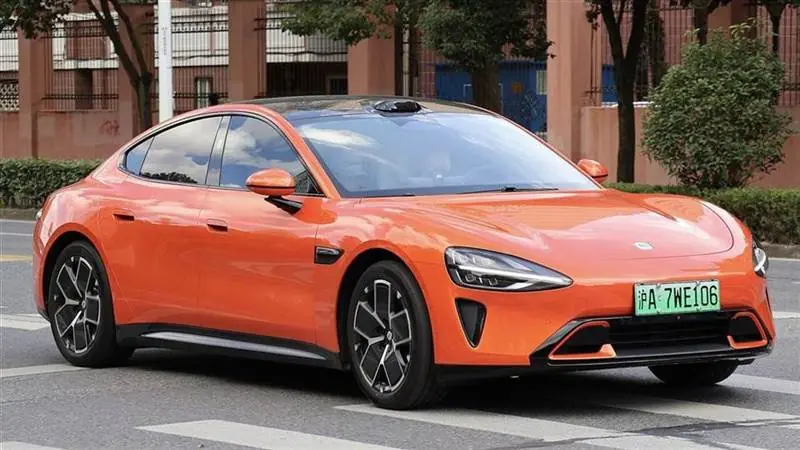
Few expected what came next. On March 28, 2024, Xiaomi launched its first car, the SU7, a full-size electric sedan, at an event in Beijing. The entry Standard version started at 215,900 yuan, roughly 30,000 US dollars at the exchange rate of the day, with the Pro at 245,900 yuan and the flagship Max at 299,900 yuan, according to Xiaomi's launch presentation. Within four minutes of the order books opening, customers had committed to more than 10,000 cars; within 27 minutes the figure passed 50,000, according to figures the company shared at the event.
Demand that outran the factory
Xiaomi's first-quarter 2024 results, published in May of that year, put cumulative locked-in orders for the SU7 series at 88,063 vehicles as of April 30, barely a month after launch. Deliveries began on April 3, 2024, and from the start the constraint was never demand but output at the company's new plant in Beijing. The 100,000th SU7 rolled off the line on November 13, 2024, just 230 days after deliveries began, which Xiaomi described as the fastest such ramp for a Chinese EV newcomer.
For the full year 2024, Xiaomi delivered more than 135,000 SU7s even though production had only started in late March; the company's annual report put the figure at 136,854 vehicles. No Chinese EV startup had ever sold that many cars in a first, partial year. It happened in the premium electric sedan segment, one of the most contested corners of the most competitive car market on earth.
Specifications aimed squarely at Tesla
Xiaomi made no secret of who it was chasing. The SU7's size and pricing placed it against the Tesla Model 3 and Model S, and the flagship Max was benchmarked openly against performance cars. According to Xiaomi's published specifications, the SU7 Max pairs two electric motors producing a combined 495 kW with a large CATL-supplied ternary lithium battery on an 800-volt electrical architecture, delivering a claimed 0-100 km/h time of 2.78 seconds and a CLTC range of up to 800 kilometers, with 10-to-80-percent charging in about 19 minutes.
The software story was just as central. The SU7 runs Xiaomi's HyperOS, which ties the car into the same account and app ecosystem as the company's phones, watches and smart-home devices. Lei argued that this human-car-home integration was the product's real differentiator, and the cabin's 16.1-inch center screen, interchangeable physical shortcut buttons and rear tablet mount generally convinced reviewers that a first-time carmaker had delivered software few incumbents could match.
SU7 Ultra: a 1,548-horsepower calling card
If the SU7 was the volume play, the SU7 Ultra was the statement. Launched on February 27, 2025, at a price of 529,900 yuan, about 73,000 US dollars according to CGTN, the Ultra is a tri-motor flagship producing 1,548 horsepower, with Xiaomi claiming 0-100 km/h in 1.98 seconds and a top speed of 350 km/h. The company said firm orders passed 6,900 within ten minutes and 10,000 within two hours of the launch, per its announcements at the event.
The Ultra also gave Xiaomi a motorsport story. A prototype lapped the Nürburgring Nordschleife in 6 minutes 46.874 seconds in late 2024, which Xiaomi said made it the fastest four-door sedan ever around the German circuit, and the production version later set a claimed record for electric executive cars at 7 minutes 4.957 seconds. A Nürburgring Limited Edition, priced at 814,900 yuan and capped at 100 units, capped the range, according to Xiaomi's June 2025 announcement.
Shaking up more than one market
The SU7's impact went well beyond its own sales curve. It demonstrated that a consumer-electronics company could design, finance, build and sell a genuinely competitive car in roughly three years, and it forced rivals across China to respond on price, technology and launch theater, with order numbers reported by the minute becoming an industry convention almost overnight. Xiaomi's approach to retail, selling through fast-expanding company stores in city centers rather than traditional dealerships, also echoed the playbook it had used in phones.
The ride has not been perfectly smooth. Waiting lists stretched for many months, and the company has faced quality questions and scrutiny over its driver-assistance marketing as volumes exploded, pressures that would test any automaker growing this fast. Chinese regulators also tightened oversight of how driver-assistance features are advertised in 2025, an industry-wide response to fast-moving claims.
By the end of 2025, Xiaomi had delivered more than 400,000 vehicles across its lineup according to company announcements, and a second-generation SU7 arrived in March 2026 with lower launch prices and a stronger standard equipment list, per Xiaomi. Whatever happens next, the SU7 has already earned its place in the industry's recent history: the car that proved a phone maker could walk into the world's toughest EV market and immediately compete at the front of it.